Why Santosh Araswilli Is More Than an International Table Tennis Player – He’s Building a Culture of Performance
 The National Reader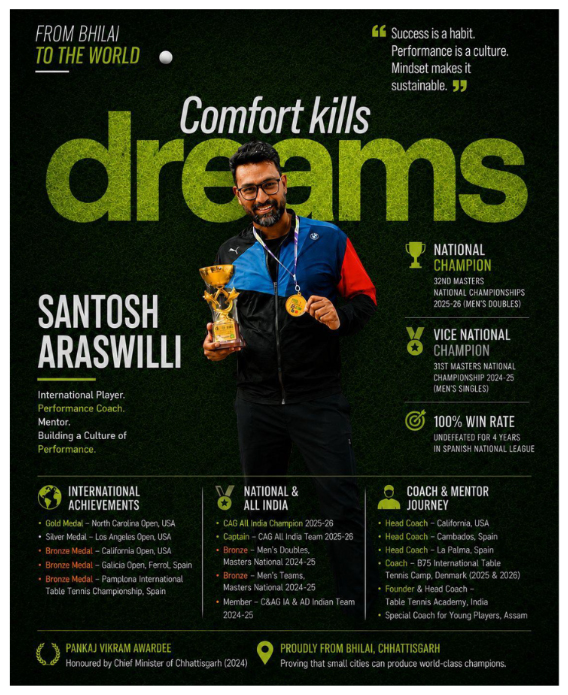
Most athletes chase medals. Few obsess over what creates them. That difference explains Santosh Araswilli. From Bhilai, Chhattisgarh, Santosh has competed across India, Spain and the United States. He has won national titles, built an international coaching footprint, and developed a playing philosophy rooted in performance psychology.
But his story is not a sudden rise. It is the outcome of years of structured, international-level development. From childhood, Santosh trained under Japanese coach K. Higuchi, building a strong technical and discipline-oriented foundation shaped by the precision of Japanese table tennis systems.
As his career evolved, that base was further sharpened through advanced coaching exposure in Spain, giving him deep familiarity with European tactical systems and competitive training methods.
The result is a player whose game reflects a rare combination:
Japanese technical discipline fused with European strategic adaptability.
That training ecosystem played a defining role in preparing him for international competition – and later, international coaching.
For Santosh, performance is not just about strokes, speed or footwork.
It is about what happens inside an athlete’s mind after losing a crucial point.
How confidence rebuilds. How discipline survives bad days. How players perform under pressure when technique alone stops being enough.
That mindset-first philosophy has shaped both sides of his journey – elite competitor and mentor. While competing at the highest level, he became National Champion in Men’s Doubles at the 32nd Masters National Championships 2025–26, Vice National Champion in Singles, maintained outstanding success in the Spanish National League, and secured medals across tournaments in the USA and Spain.
At the same time, he expanded his coaching journey internationally — working across California, Spain and Denmark, helping players improve not only technical execution, but their understanding of performance itself.
And maybe that is why Santosh’s story matters beyond table tennis.
Because this isn’t simply a story about an international athlete from a smaller Indian city. It is the story of a player and mentor shaped by Japanese discipline, European systems, and years of high-performance learning – now building a culture of performance for the next generation.
The bigger question his journey raises is simple:
Can world-class performers be built through mindset, systems, mentorship and technical depth – not geography alone?
Santosh Araswilli’s career is becoming a strong argument that they can.
About Author